
BRIEFING FOR MINE MANAGERS AND HEALTH, SAFETY AND ENVIRONMENTAL TEAMS
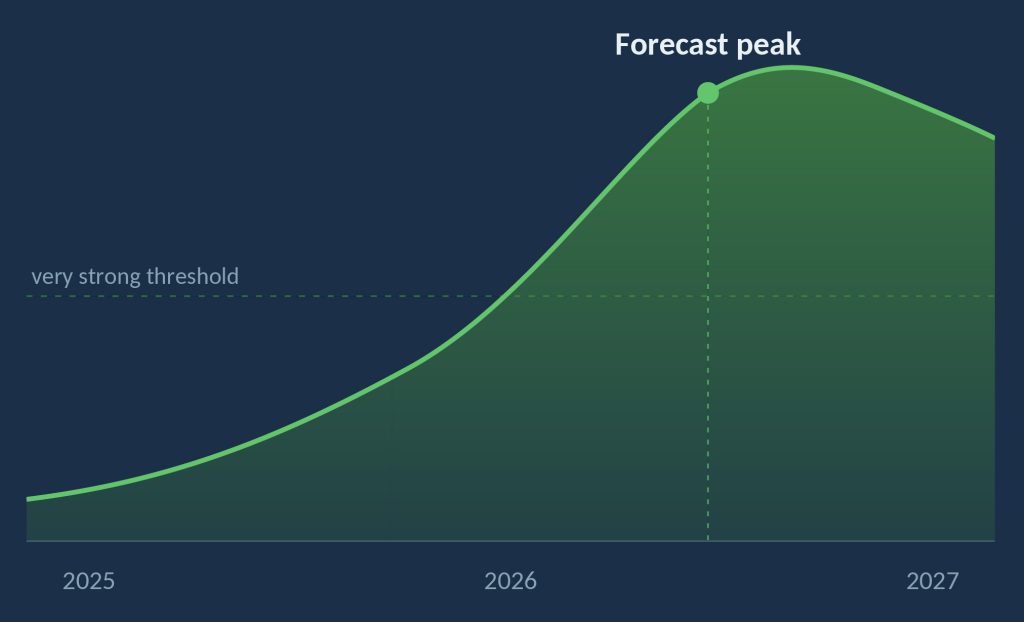
90%+
Chance of a very strong El Niño by late 2026
Oct to Dec 2026
Forecast peak of the event
Since 1950
It could be the strongest on record
A STRONG EL NIÑO IS FORMING
By the time the summer rains should arrive in late 2026, much of the interior is likely to be drier than it has been in years. The reason is a strong El Niño building in the Pacific.
El Niño shifts rainfall away from Southern Africa during the summer growing season, roughly October to April, which is when the interior mining regions receive most of their water. The current outlook is unusually firm. Forecasters put the chance of a very strong event above 90 percent through the end of 2026, with the signal peaking between October and December. There is close to a 69 percent chance the event becomes historic, stronger than any El Niño measured since 1950, and the models expect it to hold into the first months of 2027.
FULL DAMS TODAY, A THINNER BUFFER TOMORROW
The honest picture is not a crisis this week. South Africa enters this event with storage close to full. In early August 2026 the country’s dams sat at about 96 percent overall, and the Vaal system, which supplies the economic heartland, was near capacity. A full buffer is exactly what carries an operation through one poor season.
The risk is a strong and prolonged event that draws that storage down through the dry months, with the sharpest effects arriving later, into 2027. Water stored today is the cushion for the season ahead. That is why the useful moment to prepare is now, while the buffer is still full and there is time to plan, rather than during the drawdown when options narrow.
WHAT THE LAST ONE DID
We do not have to guess how this plays out. The El Niño of 2023 and 2024 gives a recent, well-documented benchmark. A dry spell of more than 50 days ran from late January into early March 2024, the longest midseason break in over a century in some central areas, and several places recorded their lowest February rainfall in about a hundred years.
Six neighbouring countries, Botswana, Lesotho, Namibia, Malawi, Zambia and Zimbabwe, declared drought states of emergency, and more than 30 million people across the region were affected. South Africa’s maize harvest fell about 22 percent. The clearest lesson for any operation is the one about buffers: sites that had stored water and reliable power carried through, while those that depended on the season as it came had no cushion when it did not arrive.
WHY A DRY SEASON IS A DUST SEASON
A drought does not only take water away. It changes the air. Drier, windier conditions with lower humidity lift more dust from stockpiles, haul roads, tips and exposed ground, and the same conditions make water-based suppression less effective because the water evaporates faster than it can hold the surface. Operations tend to reach for more water at exactly the moment there is less of it to spare.
The first cost of that is not regulatory, it is human. Fine airborne particles, the PM10 fraction and smaller, are linked to respiratory and cardiovascular harm, and a dustier dry season raises the exposure that workers and nearby communities carry. Protecting people is the reason to plan for dust before the season turns, and it is a reason that does not wait for an inspection.
THE WATER SQUEEZE ON THE NORTHERN CAPE BELT
Nowhere is the pinch clearer than the manganese and iron-ore belt of the Northern Cape, an arid region whose mines already run on a strained supply. The Vaal-Gamagara scheme, which pipes water from the Vaal River to Postmasburg, Kathu and Hotazel, was built to deliver about 34 million litres a day but supplies closer to 24 million. The pipeline is ageing and under a multi-billion-rand upgrade, and the industry has put its own money in to keep it running.
Into that already-tight system a dry season adds pressure from two sides at once. There is less water in the rivers and schemes that feed the mine, and there is more demand for water at every point where dust has to be controlled. Water for production and water for dust control end up competing for the same shrinking supply. The operations that manage this best are the ones that reduce how much water dust control needs in the first place.
SCARCER WATER COSTS MORE TO MOVE
There is a cost dimension worth naming plainly. Moving water depends on grid power, and power has become more expensive: electricity tariffs rose by roughly 9 percent in 2026. Load-shedding has eased, so the pressure this year is on cost rather than supply. When water is scarcer it has to be pumped further and lifted higher, and every additional litre used for dust suppression carries that rising cost with it. Using less water for the same dust control is therefore both an environmental and a financial saving.
HOW TO GET AHEAD OF THE DRY SEASON
The good news is that a dry season is predictable, and a predictable problem can be planned for. Four practical steps, taken now while the buffer is full, put an operation in a far stronger position when the air turns.
| Step | What it means in practice |
|---|---|
| Plan before the season | Review the dust-management plan for the coming dry months, confirm water sources and allocations, and identify the transfer points, roads and stockpiles that will become the worst dust sources when it dries out. |
| Monitor and forecast | Combine on-site dust monitoring with weather forecasting so high-dust days can be anticipated and suppression targeted where and when it is needed, rather than applied everywhere by habit. This alone saves water. |
| Reduce reliance on water alone | Water-only suppression fails fastest in the exact conditions a drought brings. Methods that bind dust at the source, using chemistry that holds through handling, keep material under control with far less water and far less reapplication. |
| Protect people first | Treat worker and community exposure as the measure that matters. A drier, dustier season is a health and safety issue before it is anything else, and planning for it protects the workforce through the months when exposure is highest. |
None of this requires waiting for a bad month to act. The independent evidence is encouraging: well-designed suppression can cut water use by more than 80 percent while holding or improving dust control, and treated surfaces can stay bound for far longer than a water cart can manage. The operations that come through a strong El Niño in good shape will be the ones that treated the dry season as a plan, not a surprise.
The most reliable way to get this right is to plan the dry season with a dust-control specialist who can assess the site, model where the dust and water pressure will land, and design suppression that works at low water.