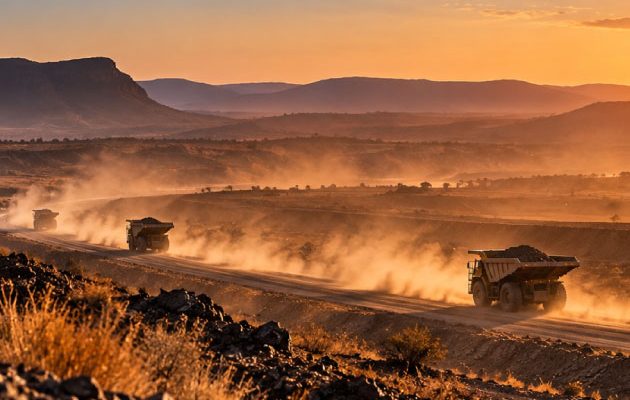
The Dry Season Ahead

BRIEFING FOR MINE MANAGERS AND HEALTH, SAFETY AND ENVIRONMENTAL TEAMS
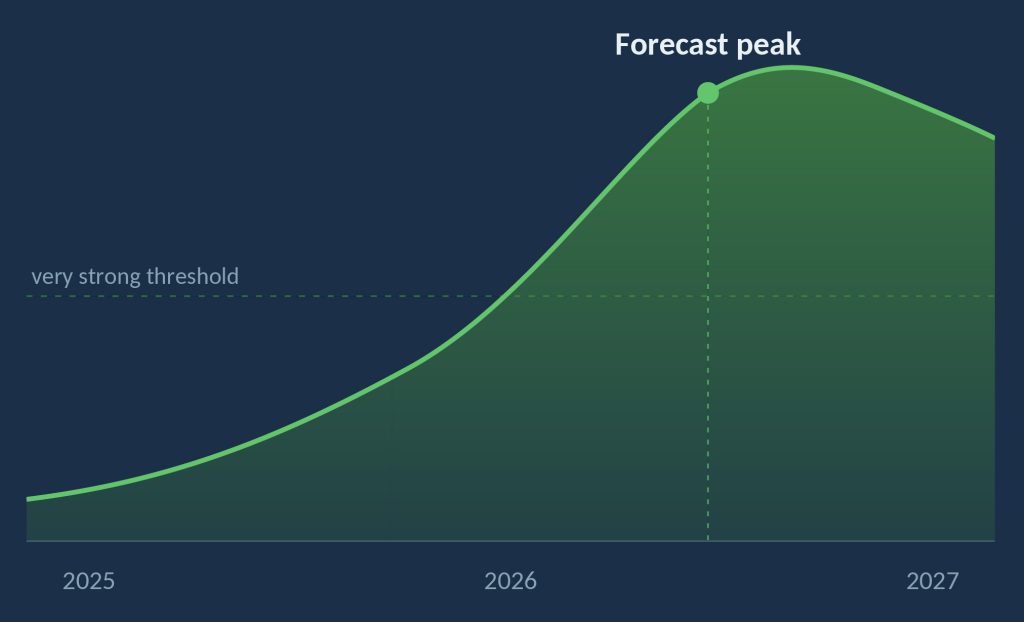
90%+

Chance of a very strong El Niño by late 2026

Oct to Dec 2026

Forecast peak of the event

Since 1950

It could be the strongest on record

A STRONG EL NIÑO IS FORMING

By the time the summer rains should arrive in late 2026, much of the interior is likely to be drier than it has been in years. The reason is a strong El Niño building in the Pacific.

El Niño shifts rainfall away from Southern Africa during the summer growing season, roughly October to April, which is when the interior mining regions receive most of their water. The current outlook is unusually firm. Forecasters put the chance of a very strong event above 90 percent through the end of 2026, with the signal peaking between October and December. There is close to a 69 percent chance the event becomes historic, stronger than any El Niño measured since 1950, and the models expect it to hold into the first months of 2027.

Greater than 90%

Chance of a very strong El Niño through late 2026, peaking October to December, with a roughly 69 percent chance of the strongest event on record since 1950.

FULL DAMS TODAY, A THINNER BUFFER TOMORROW

The honest picture is not a crisis this week. South Africa enters this event with storage close to full. In early August 2026 the country’s dams sat at about 96 percent overall, and the Vaal system, which supplies the economic heartland, was near capacity. A full buffer is exactly what carries an operation through one poor season.

The risk is a strong and prolonged event that draws that storage down through the dry months, with the sharpest effects arriving later, into 2027. Water stored today is the cushion for the season ahead. That is why the useful moment to prepare is now, while the buffer is still full and there is time to plan, rather than during the drawdown when options narrow.

~96%

National dam storage in early August 2026. The buffer is full now. A strong, prolonged dry season is what draws it down.

WHAT THE LAST ONE DID

We do not have to guess how this plays out. The El Niño of 2023 and 2024 gives a recent, well-documented benchmark. A dry spell of more than 50 days ran from late January into early March 2024, the longest midseason break in over a century in some central areas, and several places recorded their lowest February rainfall in about a hundred years.

Six neighbouring countries, Botswana, Lesotho, Namibia, Malawi, Zambia and Zimbabwe, declared drought states of emergency, and more than 30 million people across the region were affected. South Africa’s maize harvest fell about 22 percent. The clearest lesson for any operation is the one about buffers: sites that had stored water and reliable power carried through, while those that depended on the season as it came had no cushion when it did not arrive.

50+ days

The longest mid-season dry spell in over a century, early 2024. Six neighbouring countries declared drought emergencies.

WHY A DRY SEASON IS A DUST SEASON

A drought does not only take water away. It changes the air. Drier, windier conditions with lower humidity lift more dust from stockpiles, haul roads, tips and exposed ground, and the same conditions make water-based suppression less effective because the water evaporates faster than it can hold the surface. Operations tend to reach for more water at exactly the moment there is less of it to spare.

The first cost of that is not regulatory, it is human. Fine airborne particles, the PM10 fraction and smaller, are linked to respiratory and cardiovascular harm, and a dustier dry season raises the exposure that workers and nearby communities carry. Protecting people is the reason to plan for dust before the season turns, and it is a reason that does not wait for an inspection.

3%+ moisture

Is what water-only suppression typically needs to reach around 80 percent dust reduction, and it evaporates faster as humidity falls
through a dry season.

THE WATER SQUEEZE ON THE NORTHERN CAPE BELT

Nowhere is the pinch clearer than the manganese and iron-ore belt of the Northern Cape, an arid region whose mines already run on a strained supply. The Vaal-Gamagara scheme, which pipes water from the Vaal River to Postmasburg, Kathu and Hotazel, was built to deliver about 34 million litres a day but supplies closer to 24 million. The pipeline is ageing and under a multi-billion-rand upgrade, and the industry has put its own money in to keep it running.

Into that already-tight system a dry season adds pressure from two sides at once. There is less water in the rivers and schemes that feed the mine, and there is more demand for water at every point where dust has to be controlled. Water for production and water for dust control end up competing for the same shrinking supply. The operations that manage this best are the ones that reduce how much water dust control needs in the first place.

24 of 34

Million litres a day. The belt’s main water scheme already delivers well below its design capacity, before a drought is added.

SCARCER WATER COSTS MORE TO MOVE

There is a cost dimension worth naming plainly. Moving water depends on grid power, and power has become more expensive: electricity tariffs rose by roughly 9 percent in 2026. Load-shedding has eased, so the pressure this year is on cost rather than supply. When water is scarcer it has to be pumped further and lifted higher, and every additional litre used for dust suppression carries that rising cost with it. Using less water for the same dust control is therefore both an environmental and a financial saving.

~9%

Rise in electricity tariffs in 2026. Scarcer water pumped further costs more, so every litre saved on dust control counts twice.

HOW TO GET AHEAD OF THE DRY SEASON

The good news is that a dry season is predictable, and a predictable problem can be planned for. Four practical steps, taken now while the buffer is full, put an operation in a far stronger position when the air turns.

Step What it means in practice
Plan before the season Review the dust-management plan for the coming dry months, confirm water sources and allocations, and identify the transfer points, roads and stockpiles that will become the worst dust sources when it dries out.
Monitor and forecast Combine on-site dust monitoring with weather forecasting so high-dust days can be anticipated and suppression targeted where and when it is needed, rather than applied everywhere by habit. This alone saves water.
Reduce reliance on water alone Water-only suppression fails fastest in the exact conditions a drought brings. Methods that bind dust at the source, using chemistry that holds through handling, keep material under control with far less water and far less
reapplication.
Protect people firstTreat worker and community exposure as the measure that matters. A drier, dustier season is a health and safety issue before it is anything else, and planning for it protects the workforce through the months when exposure is highest.

None of this requires waiting for a bad month to act. The independent evidence is encouraging: well-designed suppression can cut water use by more than 80 percent while holding or improving dust control, and treated surfaces can stay bound for far longer than a water cart can manage. The operations that come through a strong El Niño in good shape will be the ones that treated the dry season as a plan, not a surprise.

80%+ less water

The water saving is achievable with well-designed suppression, at equal or better dust control. A predictable dry season can be planned for, not reacted to.

The most reliable way to get this right is to plan the dry season with a dust-control specialist who can assess the site, model where the dust and water pressure will land, and design suppression that works at low water.
Download ArticleContact Us

The Cost of Water in Trucked Manganese

THE PROBLEM

Approximately 10 million tonnes of manganese ore move from the Kalahari Manganese Belt to export terminals eacH year by road. The dominant corridor, Hotazel to Ngqura, covers roughly 1,100 km. Water is the most commonly used dust suppressant, but not the most cost-effective. Every litre added at the mine must then be hauled, handled, and ultimately paid for as dead weight on the invoice.

WHAT MOISTURE COSTS

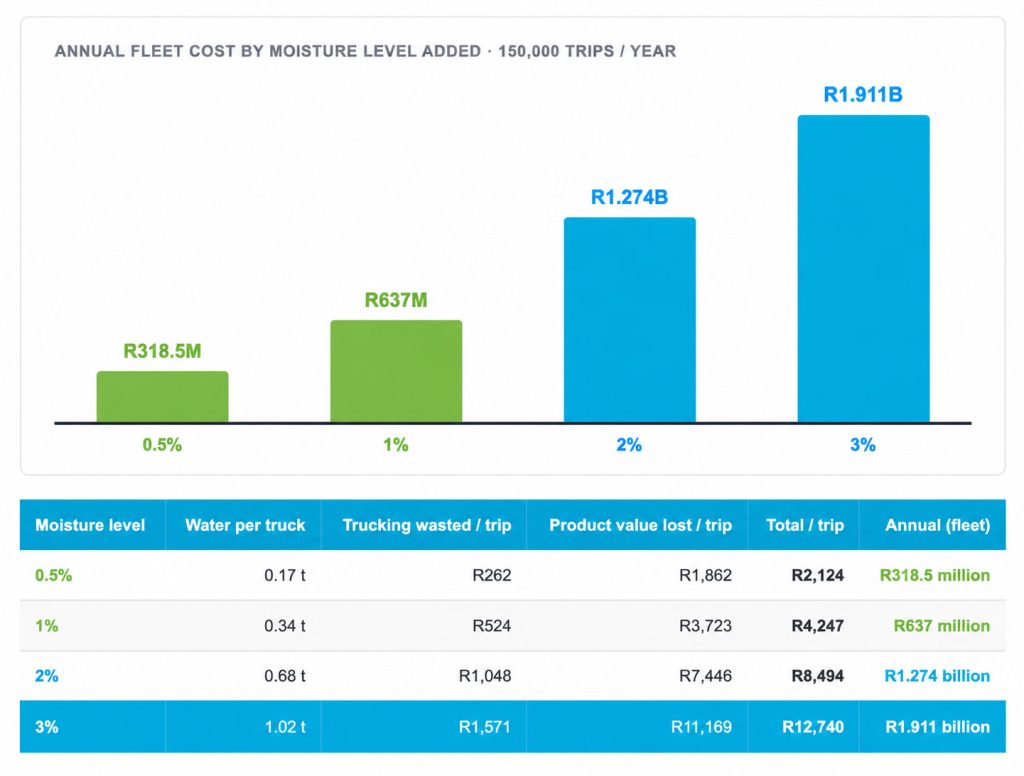
On a 34-tonne truck, every 1 % of moisture equals 0.34 tonnes of water. That water displaces saleable ore and is deducted from the invoice before the mine is paid. The cost scales directly with moisture: the chart shows the annual bill to a 500-truck fleet at each level; the table breaks it down per trip.

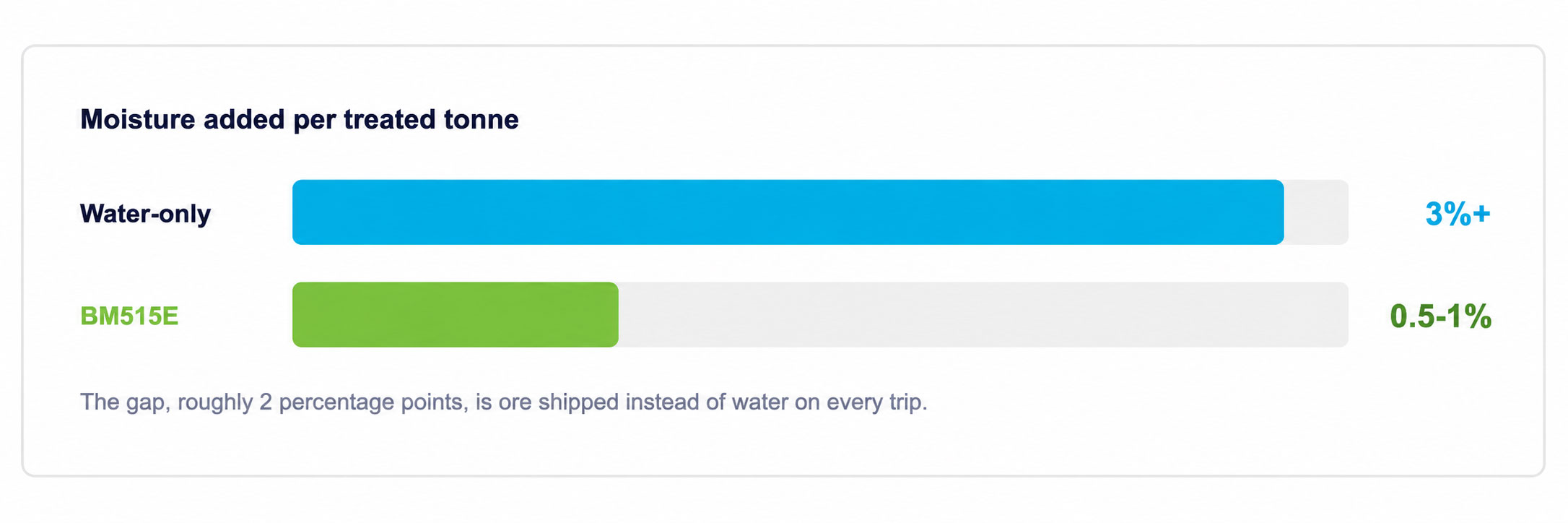
Water-only dust suppression typically adds 3%+ moisture. BM515E achieves better dust control at 0.5 to 1 %. The gap between those two rows is the opportunity.

Basis: trucking rate R1 .40/tkm over 1,100 km (R1 ,540/tonne, of which -R118 is diesel at R30.64/litre); manganese priced per dry metric tonne unit (dmtu), so all moisture is deducted before payment. Fleet: 500 trucks, 34-tonne payload, 150,000 trips per year.

The Treatment Gap Nobody Talks About

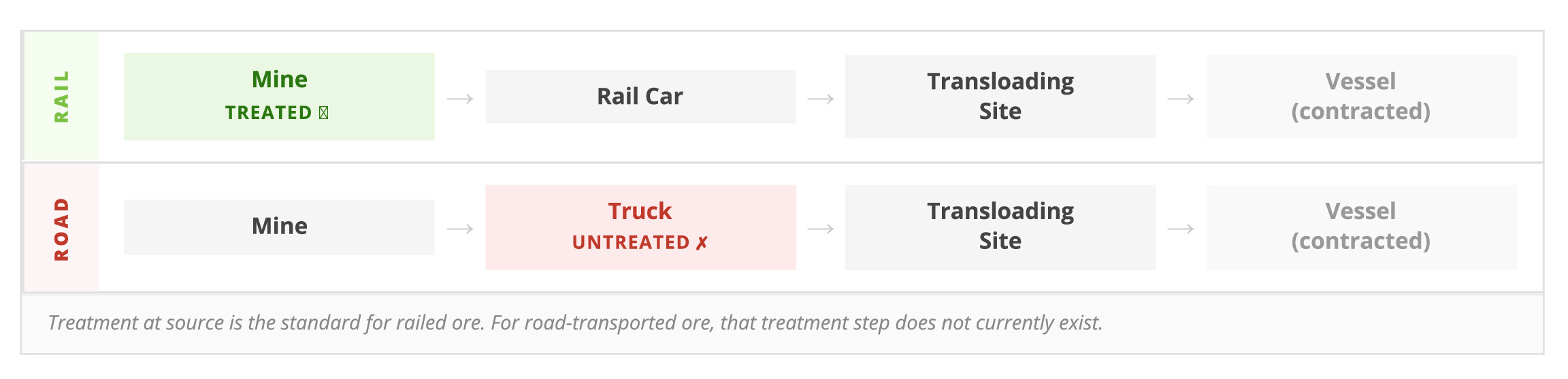
Railed ore is chemically treated at the mines prior to shipment. Fine particles are bound to coarser material. Surface tension is modified to enhance this binding process. The treated material is stable, typically requiring under 0.5% moisture addition to achieve over 90% dust reduction, and it maintains that stability for the journey from the Northern Cape to the coast.

The Benmarc Solution: Treat at Source, Travel Clean

BM515E binds dust fines to larger ore particles with a single application at the loading point. It achieves 90%+ dust reduction at just 0.5 to 1 % moisture, against the 3%+ and roughly 80% reduction that water-only methods deliver with constant reapplication. The binding effect persists for up to 14 days and carries through multiple transfer points, so the load travels clean from mine to port without re-wetting.

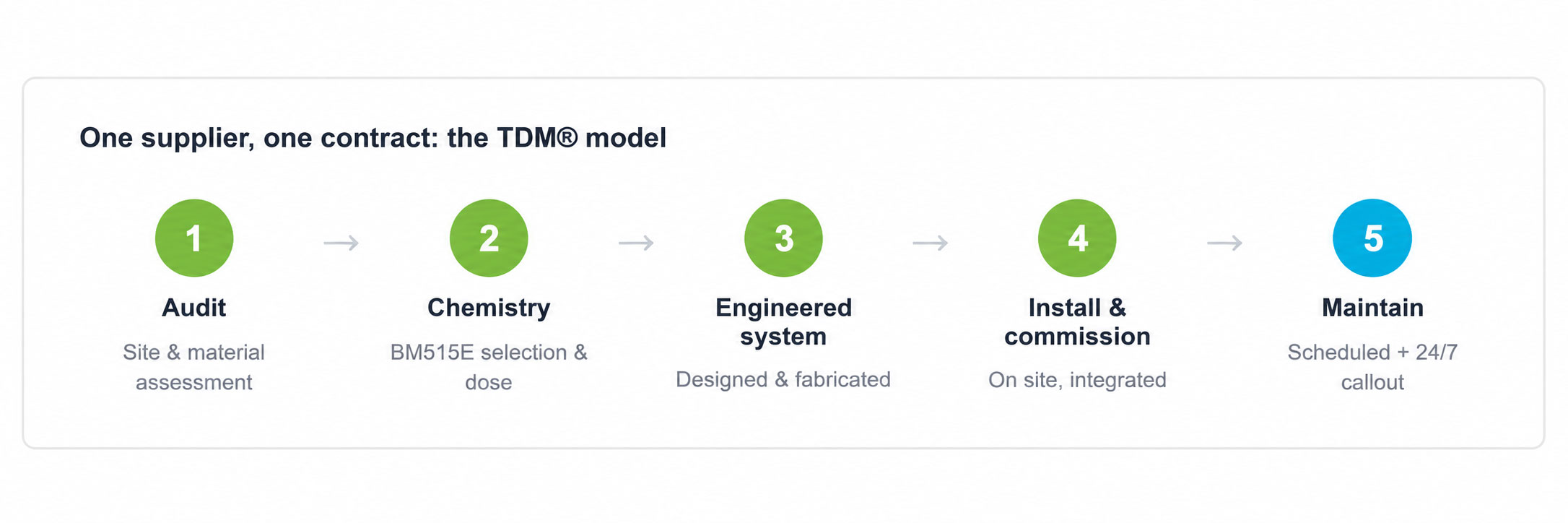
Benmarc is not a chemical supplier. Through its Total Dust Management model, TOM® (Total Dust Management), it delivers chemistry, engineering, fabrication, installation, and maintenance under one supplier, on one contract. With the National Dust  Control Regulations 2026 tightening limits and NEMA Section 24G fines reaching R5 million, treating dust at source is now a compliance position as much as a cost one.

BEYOND THE DIRECT COST

The per-trip economics capture only the direct payload cost. Excess moisture creates compounding costs downstream:

Port penalties and TML compliance

Manganese ore fines are classified as Group A cargo under the IMSBC Code, and may liquefy if shipped above their Transportable Moisture Limit. Cargo exceeding TML cannot be loaded, causing demurrage of US$15,000 to 50,000 per day.  Every drop of water added at the mine reduces the available moisture budget for safe shipping.

Material handling and conveyor life

Wet manganese sticks to truck bodies, chutes, and conveyor belts. Belt carry-back accounts for up to 3% of throughput as waste. Chute blockages from wet fines can shut down processing for hours.

The Markman crisis

In June 2026, the Daily Maverick reported that the Markman airshed in Gqeberha has reached a state of saturation, with dust deposition far exceeding the NDCR non-residential limit of 1,200 mg/m2/day. This crisis is about ore treatment: material arriving at port with excessive fines and inadequate dust control generates emissions at every handling step.

THE BOTTOM LINE

Water is the expensive option

THE PROBLEM

R1.911bn

The annual cost of 3% unnecessary moisture across a 500-truck fleet:
hauled water and displaced ore, paid for at every trip.

THE SOLUTION

0.5 - 1%

BM515E moisture addition, from a single application that binds dust at source.

90%+

dust suppression.

14 days

residual effect

THE DIFFERENCE

R1.274bn

Annual recoverable value from a 2% moisture reduction: ore shipped instead of water, on the same fleet, over the same road.

Download Article

When Truck Haulage Increases, So Does the Dust

THE SCALE OF THE PROBLEM

South Africa shipped a record volume of manganese in 2025. Nearly 40% was moved by road, without any dust treatment, when it left the mine.

26.2

MILLION TONNES

Manganese exported from South Africa in 2025, a record year for the sector.

~10

MILLION TONNES

Estimated volume moved by road,bypassing all existing dust treatmentinfrastructure at mine loadouts

40%

COST PREMIUM

Higher cost per tonne by road vs rail,a structural margin impact for everyoperator using trucks

South Africa’s manganese export chain was built around a rail-centric model. The chemistry and systems developedto suppress dust along that chain were designed accordingly: ore is treated at the mine before it is loaded intocontainers. Treatment happens at source, before the material is sealed and long before it reaches the port.

When ore moves by truck instead of rail, it bypasses that treatment entirely. There is no chemical suppressionapplied at the bulk truck loadout. The ore leaves the mine in the same condition it was screened and crushed, and itarrives at the transloading site or port exactly that way it left: DUSTY.

This document examines what that means in practice for transloading sites, port terminal operations, andsurrounding communities, which needs to be addressed given the recent regulation NDCR 2026.

The Treatment Gap Nobody Talks About

Railed ore is chemically treated at the mines prior to shipment. Fine particles are bound to coarser material. Surface tension is modified to enhance this binding process. The treated material is stable, typically requiring under 0.5% moisture addition to achieve over 90% dust reduction, and it maintains that stability for the journey from the Northern Cape to the coast.

“The ore travels 900 kilometres and arrives at the transloading site or port in the same untreated condition it left the mine.”

Trucked ore has none of those properties. There is no treatment infrastructure at the truck loading point. No chemical dosing system. No moisture addition protocol. No dust-binding agent applied before the tarp goes over the load. The ore that was screened and crushed at the mine, including all the fine fractions that process generates, is the ore that drives out the gate to its off loading point.

It travels through towns. It moves over the dry Northern Cape plains in conditions that lift fine material from every unsealed surface. When it arrives at the transloading terminal, it arrives as it left: entirely untreated.

This is not a criticism of road transport as a logistics choice. The shift to trucking happened under structural pressure, driven by persistent Transnet rail capacity constraints that cost the mining industry an estimated R50 billion in lost export opportunities over a three-year period. The problem is narrower: the dust management infrastructure built around the rail model was not incorporated for truck transport.

What Untreated Ore Means at the Terminal

Port authorities, transloading operators, and terminal managers are not strangers to dust. The handling of bulkmineral ore (manganese, iron ore, chrome, coal) generates dust events that are inherent to the process. What mostport operations have come to understand, over years of working with mining customers, is how treated ore behavesdifferently from untreated ore during handling.

Ore that has been chemically treated at the mine arrives with its fine particles already bound to coarser material.During discharge, stockpile formation, and eventual re-loading once a vessel is contracted, dust-generating eventsare materially reduced. Fine fractions, meaning particles under 10 micrometres in diameter that evade the body’snatural defences and penetrate deepest into lung tissue, are suppressed at the particle level before they everbecome airborne.

Untreated ore generates more dust per handling event. It produces higher frequency and intensity of visible plumesduring discharge. Maintenance requirements on dust suppression infrastructure increase. And the complianceexposure falls on the transloading operator and port, regardless of what condition the ore arrived in.

“The port’s compliance position is measured against the dust it generates, not the condition ofthe ore it receives.”

For a port authority or transloading operator, this creates an unusual operational reality: a portion of the terminal’scompliance exposure is a direct function of decisions made at a mine 900 kilometres away. Whether ore was treatedbefore loading onto trucks, or whether trucks were used instead of rail in the first place, those upstream decisionsdirectly affect the downstream compliance register. The transloading site has no visibility into those decisions and,under the current transport model, no contractual mechanism to influence them.

The Compliance Exposure

The National Dust Control Regulations 2026 (NDCR 2026), gazetted on 31 March 2026 under the NationalEnvironmental Management: Air Quality Act (NEMAQA), sets dustfall limits measured at the operational boundary.Exceedance, including dust that migrates beyond the fence line into residential areas, constitutes non-complianceregardless of where in the handling chain the dust originated.

NDCR 2026 - THE KEY COMPLIANCE POINT

Non-compliance triggers enforcement action, fines, and operational restrictions under NEMAQA. The fact that ore arrived at the transloading site or port untreated is not a mitigating factor. The compliance obligation belongs to the operator generating the dust, not to whoever loaded the truck.

2022

Carte Blanche aired “Manganese Road”,documenting communities along the truckcorridor coated in black manganese dust

26%

Of manganese mine workers in Hotazelshowed Parkinson’s-like symptoms in apublished research study (Washington Post,2023)

2027

Transnet’s deferred deadline to relocate itsGqeberha manganese facility away fromsurrounding residential areas

The structural shift is not temporary. Rail capacity reform, including private operator licensing, may eventuallyrestore rail’s share of manganese volume. That outcome is years away and contingent on capital and execution notyet demonstrated at scale. In the interim, transloading terminals and ports are absorbing ore that was not designedto arrive in its current state, at volumes that are not decreasing.

What a Different Model Looks Like

The principle Benmarc Environmental has applied across manganese and iron ore operations for nearly threedecades does not change regardless of transport mode: treat the material at source, before it enters the transportchain, and every downstream handling event is cleaner, more manageable, and more compliant.

When Benmarc first proposed treating ore at the mine rather than managing dust at the port or transloadingterminal, it was counterintuitive. The assumption across the industry was that dust was a terminal problem, to besolved at the point of offloading. Benmarc’s position was the opposite: solve it where the ore is prepared, before itmoves. That approach has been validated across more than 200 installations and nearly 30 years of operations inthe South African mining sector.

“Treat at source. Every downstream operation handles the material better — and thecompliance obligation moves with the solution, not with the ore.”

The same logic applies to road-transported ore. The point of treatment shifts to the truck loading point. The equipment must be mobile and configurable rather than fixed to a rail loadout. The outcome is the same: ore that arrives at the transloading site already treated does not generate the dust events, the maintenance burden, or the compliance exposure that untreated ore does.

The problem is not the volume of trucks. It is that 10 million tonnes of ore is now moving without the dust management the industry built its compliance model around. Right now, nobody in the logistics chain owns that gap.

Download Article