
THE PROBLEM
Approximately 10 million tonnes of manganese ore move from the Kalahari Manganese Belt to export terminals eacH year by road. The dominant corridor, Hotazel to Ngqura, covers roughly 1,100 km. Water is the most commonly used dust suppressant, but not the most cost-effective. Every litre added at the mine must then be hauled, handled, and ultimately paid for as dead weight on the invoice.
WHAT MOISTURE COSTS
On a 34-tonne truck, every 1 % of moisture equals 0.34 tonnes of water. That water displaces saleable ore and is deducted from the invoice before the mine is paid. The cost scales directly with moisture: the chart shows the annual bill to a 500-truck fleet at each level; the table breaks it down per trip.
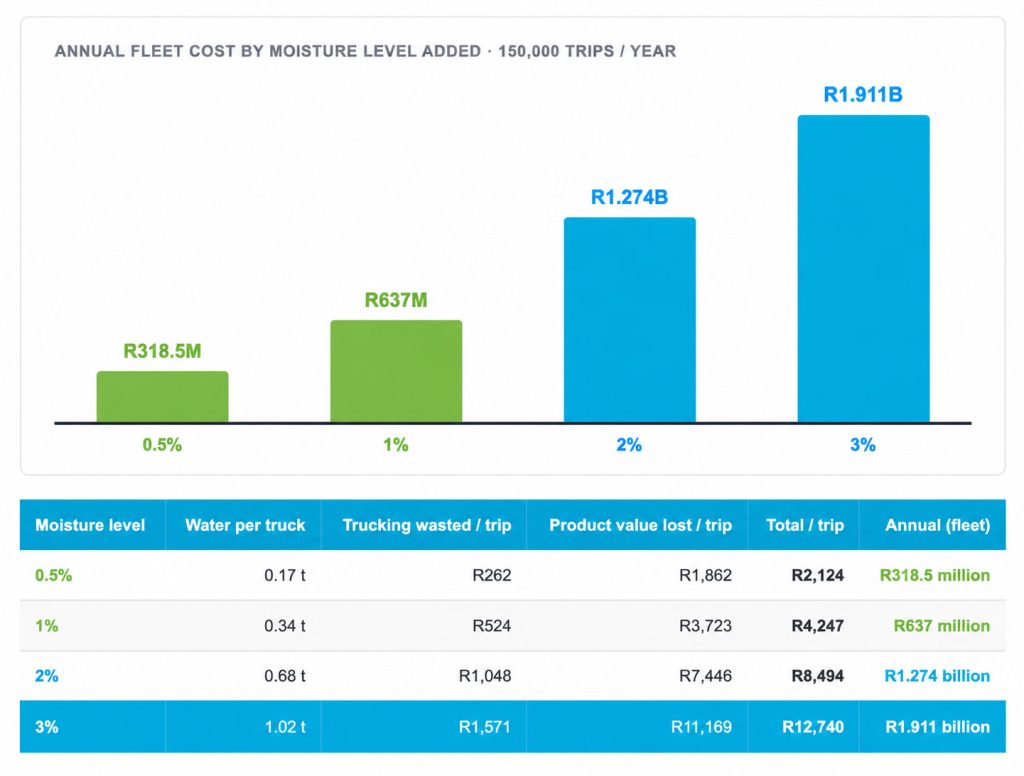
Basis: trucking rate R1 .40/tkm over 1,100 km (R1 ,540/tonne, of which -R118 is diesel at R30.64/litre); manganese priced per dry metric tonne unit (dmtu), so all moisture is deducted before payment. Fleet: 500 trucks, 34-tonne payload, 150,000 trips per year.
The Treatment Gap Nobody Talks About
Railed ore is chemically treated at the mines prior to shipment. Fine particles are bound to coarser material. Surface tension is modified to enhance this binding process. The treated material is stable, typically requiring under 0.5% moisture addition to achieve over 90% dust reduction, and it maintains that stability for the journey from the Northern Cape to the coast.
The Benmarc Solution: Treat at Source, Travel Clean
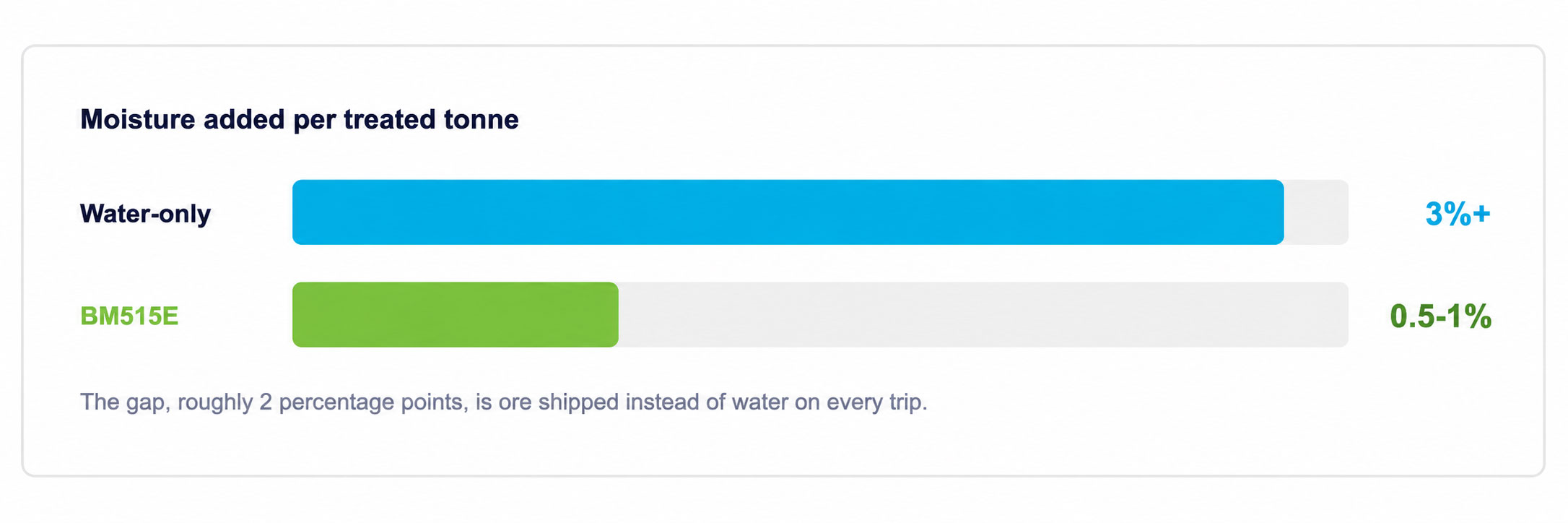
BM515E binds dust fines to larger ore particles with a single application at the loading point. It achieves 90%+ dust reduction at just 0.5 to 1 % moisture, against the 3%+ and roughly 80% reduction that water-only methods deliver with constant reapplication. The binding effect persists for up to 14 days and carries through multiple transfer points, so the load travels clean from mine to port without re-wetting.
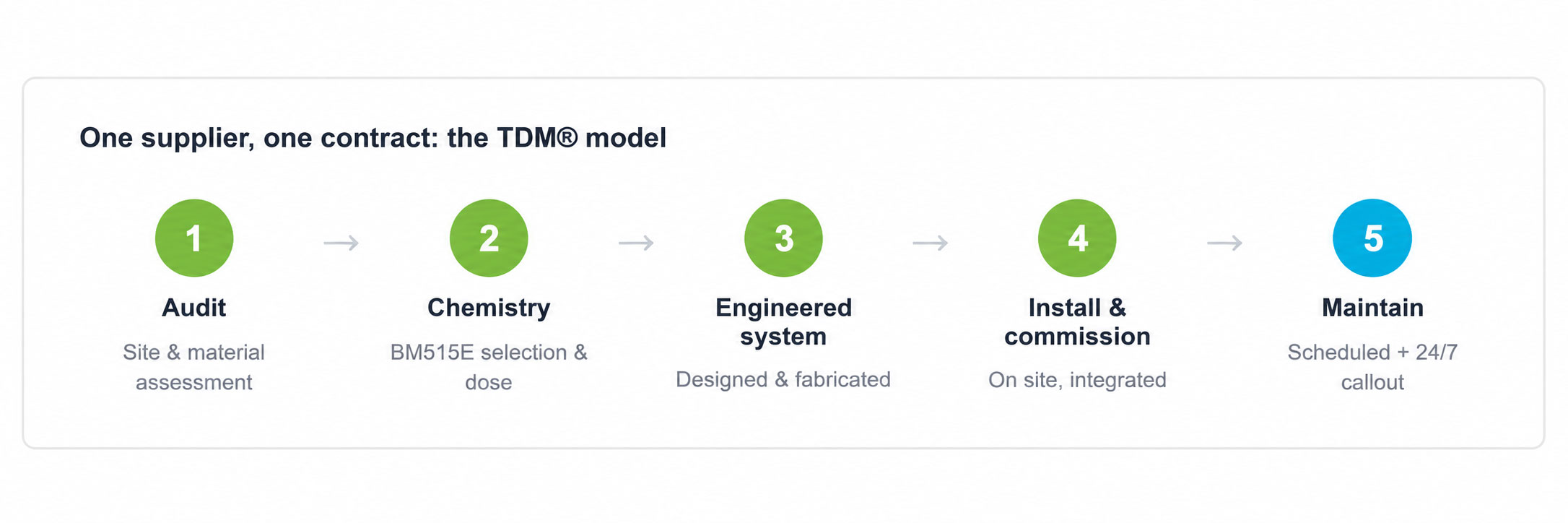
Benmarc is not a chemical supplier. Through its Total Dust Management model, TOM® (Total Dust Management), it delivers chemistry, engineering, fabrication, installation, and maintenance under one supplier, on one contract. With the National Dust Control Regulations 2026 tightening limits and NEMA Section 24G fines reaching R5 million, treating dust at source is now a compliance position as much as a cost one.
BEYOND THE DIRECT COST
The per-trip economics capture only the direct payload cost. Excess moisture creates compounding costs downstream:
THE BOTTOM LINE
Water is the expensive option
THE PROBLEM
R1.911bn
The annual cost of 3% unnecessary moisture across a 500-truck fleet:
hauled water and displaced ore, paid for at every trip.
THE SOLUTION
0.5 - 1%
BM515E moisture addition, from a single application that binds dust at source.
90%+
dust suppression.
14 days
residual effect