
THE SCALE OF THE PROBLEM
South Africa shipped a record volume of manganese in 2025. Nearly 40% was moved by road, without any dust treatment, when it left the mine.
26.2
MILLION TONNES
Manganese exported from South Africa in 2025, a record year for the sector.
~10
MILLION TONNES
Estimated volume moved by road,bypassing all existing dust treatmentinfrastructure at mine loadouts
40%
COST PREMIUM
Higher cost per tonne by road vs rail,a structural margin impact for everyoperator using trucks
South Africa’s manganese export chain was built around a rail-centric model. The chemistry and systems developedto suppress dust along that chain were designed accordingly: ore is treated at the mine before it is loaded intocontainers. Treatment happens at source, before the material is sealed and long before it reaches the port.
When ore moves by truck instead of rail, it bypasses that treatment entirely. There is no chemical suppressionapplied at the bulk truck loadout. The ore leaves the mine in the same condition it was screened and crushed, and itarrives at the transloading site or port exactly that way it left: DUSTY.
This document examines what that means in practice for transloading sites, port terminal operations, andsurrounding communities, which needs to be addressed given the recent regulation NDCR 2026.
The Treatment Gap Nobody Talks About
Railed ore is chemically treated at the mines prior to shipment. Fine particles are bound to coarser material. Surface tension is modified to enhance this binding process. The treated material is stable, typically requiring under 0.5% moisture addition to achieve over 90% dust reduction, and it maintains that stability for the journey from the Northern Cape to the coast.
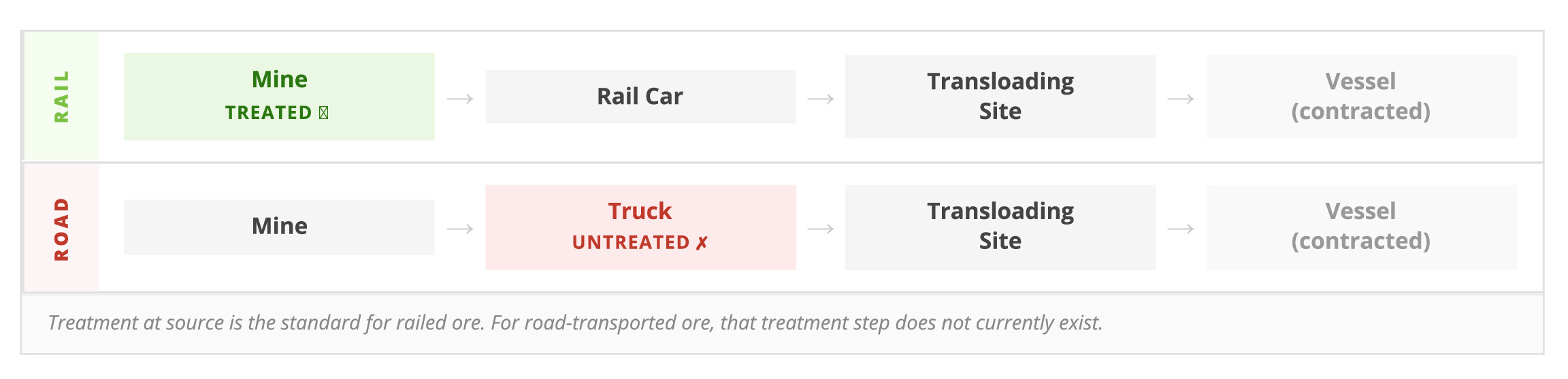
Trucked ore has none of those properties. There is no treatment infrastructure at the truck loading point. No chemical dosing system. No moisture addition protocol. No dust-binding agent applied before the tarp goes over the load. The ore that was screened and crushed at the mine, including all the fine fractions that process generates, is the ore that drives out the gate to its off loading point.
It travels through towns. It moves over the dry Northern Cape plains in conditions that lift fine material from every unsealed surface. When it arrives at the transloading terminal, it arrives as it left: entirely untreated.
This is not a criticism of road transport as a logistics choice. The shift to trucking happened under structural pressure, driven by persistent Transnet rail capacity constraints that cost the mining industry an estimated R50 billion in lost export opportunities over a three-year period. The problem is narrower: the dust management infrastructure built around the rail model was not incorporated for truck transport.
What Untreated Ore Means at the Terminal
Port authorities, transloading operators, and terminal managers are not strangers to dust. The handling of bulkmineral ore (manganese, iron ore, chrome, coal) generates dust events that are inherent to the process. What mostport operations have come to understand, over years of working with mining customers, is how treated ore behavesdifferently from untreated ore during handling.
Ore that has been chemically treated at the mine arrives with its fine particles already bound to coarser material.During discharge, stockpile formation, and eventual re-loading once a vessel is contracted, dust-generating eventsare materially reduced. Fine fractions, meaning particles under 10 micrometres in diameter that evade the body’snatural defences and penetrate deepest into lung tissue, are suppressed at the particle level before they everbecome airborne.
Untreated ore generates more dust per handling event. It produces higher frequency and intensity of visible plumesduring discharge. Maintenance requirements on dust suppression infrastructure increase. And the complianceexposure falls on the transloading operator and port, regardless of what condition the ore arrived in.
For a port authority or transloading operator, this creates an unusual operational reality: a portion of the terminal’scompliance exposure is a direct function of decisions made at a mine 900 kilometres away. Whether ore was treatedbefore loading onto trucks, or whether trucks were used instead of rail in the first place, those upstream decisionsdirectly affect the downstream compliance register. The transloading site has no visibility into those decisions and,under the current transport model, no contractual mechanism to influence them.
The Compliance Exposure
The National Dust Control Regulations 2026 (NDCR 2026), gazetted on 31 March 2026 under the NationalEnvironmental Management: Air Quality Act (NEMAQA), sets dustfall limits measured at the operational boundary.Exceedance, including dust that migrates beyond the fence line into residential areas, constitutes non-complianceregardless of where in the handling chain the dust originated.
NDCR 2026 - THE KEY COMPLIANCE POINT
Non-compliance triggers enforcement action, fines, and operational restrictions under NEMAQA. The fact that ore arrived at the transloading site or port untreated is not a mitigating factor. The compliance obligation belongs to the operator generating the dust, not to whoever loaded the truck.
2022
Carte Blanche aired “Manganese Road”,documenting communities along the truckcorridor coated in black manganese dust
26%
Of manganese mine workers in Hotazelshowed Parkinson’s-like symptoms in apublished research study (Washington Post,2023)
2027
Transnet’s deferred deadline to relocate itsGqeberha manganese facility away fromsurrounding residential areas
The structural shift is not temporary. Rail capacity reform, including private operator licensing, may eventuallyrestore rail’s share of manganese volume. That outcome is years away and contingent on capital and execution notyet demonstrated at scale. In the interim, transloading terminals and ports are absorbing ore that was not designedto arrive in its current state, at volumes that are not decreasing.
What a Different Model Looks Like
The principle Benmarc Environmental has applied across manganese and iron ore operations for nearly threedecades does not change regardless of transport mode: treat the material at source, before it enters the transportchain, and every downstream handling event is cleaner, more manageable, and more compliant.
When Benmarc first proposed treating ore at the mine rather than managing dust at the port or transloadingterminal, it was counterintuitive. The assumption across the industry was that dust was a terminal problem, to besolved at the point of offloading. Benmarc’s position was the opposite: solve it where the ore is prepared, before itmoves. That approach has been validated across more than 200 installations and nearly 30 years of operations inthe South African mining sector.
The same logic applies to road-transported ore. The point of treatment shifts to the truck loading point. The equipment must be mobile and configurable rather than fixed to a rail loadout. The outcome is the same: ore that arrives at the transloading site already treated does not generate the dust events, the maintenance burden, or the compliance exposure that untreated ore does.
The problem is not the volume of trucks. It is that 10 million tonnes of ore is now moving without the dust management the industry built its compliance model around. Right now, nobody in the logistics chain owns that gap.